
Top 5 HVAC Sensors for Energy Efficiency in Smart Buildings

Top 5 HVAC Sensors for Energy Efficiency in Smart Buildings The Quick Answer: Which Sensors Save Money? If you want to reduce energy bills in a commercial building, you need “Demand-Controlled” operations. Here are the top 5 HVAC sensors that make this possible: CO2 Sensors: Enable “Demand Controlled Ventilation” (DCV)—only bringing in fresh air when people are actually in the room. Temperature & Humidity Transmitters: Ensure occupant comfort without “over-cooling” the space. Differential Pressure Sensors: Monitor air filters to prevent fans from overworking due to clogs. Air Velocity Transmitters: Measure airflow in ducts to optimize VAV (Variable Air Volume) boxes. Dew Point Sensors: Prevent dangerous condensation on chilled water pipes. Introduction: The Hidden Cost of “Blind” HVAC Systems Did you know that HVAC (Heating, Ventilation, and Air Conditioning) accounts for nearly 40% of a commercial building’s energy usage? In many older buildings, the HVAC system runs “blind.” It pumps cold air regardless of whether 5 people or 500 people are inside. It pushes air through clogged filters, wasting fan power. The solution isn’t to replace the entire chiller plant; it is to install smart HVAC sensors. These sensors act as the “eyes and ears” of your Building Management System (BMS), allowing it to make intelligent decisions that save energy. Here are the top 5 sensors Nuicon recommends for a smarter, greener building. 1. CO2 Sensors (The Energy Saver) The single biggest energy waster is heating or cooling outside air when you don’t need to. The Problem: Traditional systems bring in a fixed amount of fresh air based on maximum occupancy design. If a conference room designed for 20 people only has 2 people in it, you are wasting energy conditioning air for 18 “ghosts.” The Solution: A Carbon Dioxide (CO2) sensor measures the breath of occupants. When CO2 levels are low, the BMS closes the fresh air damper. When the room fills up, it opens. The Result: This strategy, called Demand Controlled Ventilation (DCV), can reduce HVAC energy costs by 10-30%. 2. Temperature & Humidity Transmitters These are the basics, but accuracy matters. The Role: A standard thermostat just clicks on/off. A precision Temperature and Humidity Transmitter provides a continuous analog signal (4-20mA or 0-10V) to the BMS. Why Humidity Matters: “It’s not the heat, it’s the humidity.” If humidity is high, people feel warmer. By controlling humidity separately with accurate sensors, you can actually set the room temperature higher (saving energy) while keeping occupants just as comfortable. 3. Differential Pressure (DP) Sensors Your Air Handling Unit (AHU) has filters to trap dust. Over time, these filters get clogged. The Function: A Differential Pressure Sensor measures the pressure before and after the filter. The Benefit: As the filter clogs, the pressure drop increases. Instead of running the fan harder to push air through a dirty filter (wasting electricity), the sensor alerts the maintenance team to change the filter exactly when needed—not too early, not too late. 4. Air Velocity Transmitters Pushing air through miles of ductwork requires massive fan energy. The Role: An Air Velocity Transmitter is installed inside the main ducts. It measures exactly how fast the air is moving (in meters per second). The Benefit: It ensures that VAV (Variable Air Volume) boxes are receiving the correct airflow. If the velocity is too high, the system creates noise and drafts. If it is too low, the room gets stuffy. Precise control keeps the fans running at the lowest possible speed required. 5. Dew Point Sensors This sensor is critical for protecting the building infrastructure itself. The Risk: In radiant cooling systems or on chilled water pipes, if the surface temperature drops below the “Dew Point,” water condenses. This “sweating” leads to mold growth, ceiling damage, and slippery floors. The Solution: A Dew Point Sensor monitors this limit and tells the BMS to slightly raise the chilled water temperature before condensation can form, preventing costly water damage. Frequently Asked Questions (FAQs) Q: Can these sensors connect to any BMS? A: Yes. Most modern HVAC sensors, including Nuicon’s range, use standard industrial output signals like 4-20mA, 0-10V, or Modbus RS485. These are compatible with all major BMS brands like Siemens, Honeywell, and Schneider. Q: Where should CO2 sensors be mounted? A: Since Carbon Dioxide is slightly heavier than air but mixes well, wall-mounted CO2 sensors should be placed at “breathing zone” height—typically 4 to 6 feet (1.2 to 1.8 meters) above the floor. Q: What is the lifespan of an HVAC sensor? A: Quality industrial sensors typically last 5 to 10 years. However, sensors like CO2 and Humidity drift over time and may require re-calibration every 1-2 years to maintain peak energy efficiency. Conclusion: Smart Sensors Pay for Themselves Upgrading your facility with modern HVAC sensors is one of the highest ROI (Return on Investment) projects a Facility Manager can undertake. The energy savings from Demand Controlled Ventilation alone often pay for the sensor installation in less than 12 months. At Nuicon, we manufacture & supply a complete range of building automation sensors—from duct-mount velocity probes to elegant wall-mount room units. Ready to optimize your building? Explore Nuicon’s HVAC Sensor Range or request an energy efficiency consultation. Recent Posts How to Choose the Best Coating Thickness Gauge for Metals (2025) March 3, 2026 How to Choose the Best Coating Thickness Gauge for Metals (2025) Product: Coating Thickness Gauge For Whom: Quality Control Inspectors,… Read More → Top 5 HVAC Sensors for Energy Efficiency in Smart Buildings March 3, 2026 Top 5 HVAC Sensors for Energy Efficiency in Smart Buildings The Quick Answer: Which Sensors Save Money? If you want… Read More → RTD vs Thermocouple: Which Sensor is Best for Your Industrial Application September 19, 2025 RTD vs Thermocouple: Which Sensor is Best for Your Industrial Application? The Quick Answer (For Busy Engineers – Plant Engineers,… Read More →
RTD vs Thermocouple: Which Sensor is Best for Your Industrial Application
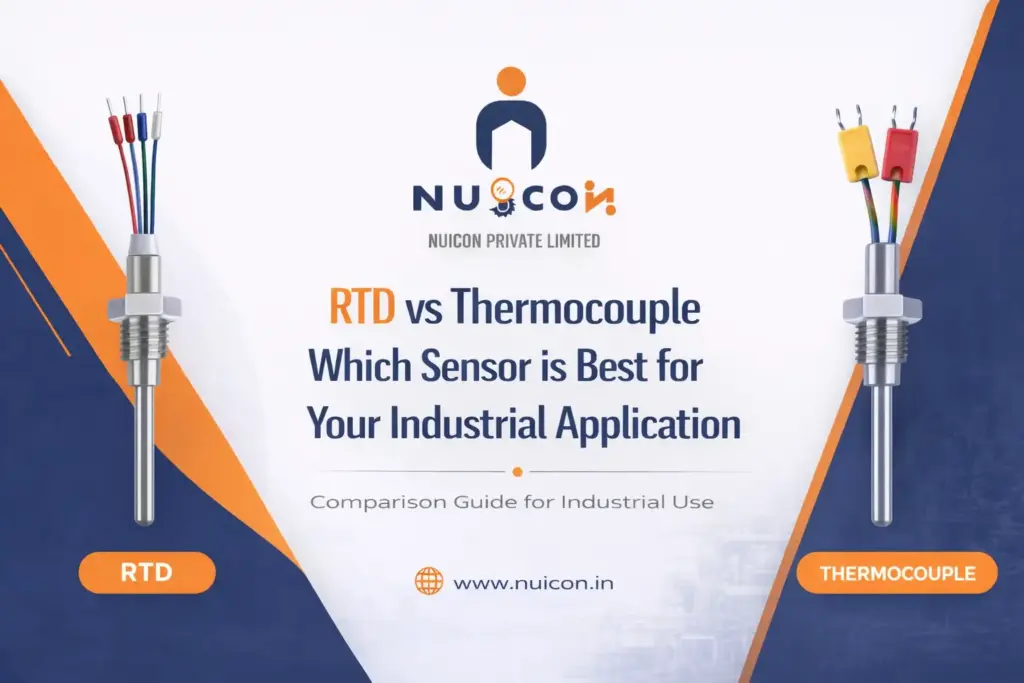
RTD vs Thermocouple: Which Sensor is Best for Your Industrial Application? The Quick Answer (For Busy Engineers – Plant Engineers, Facility Managers, OEMs.) If you need a fast decision on RTD vs Thermocouple, here is the rule of thumb: Select an RTD (Resistance Temperature Detector) if your priority is high accuracy and long-term stability within temperatures of -200°C to 850°C. They are the industry standard for Pharmaceuticals, Food & Beverage, and HVAC applications. Select a Thermocouple if your process involves extreme temperatures (up to 2300°C), heavy vibration, or requires a fast response time. They are the go-to choice for Steel, Cement Kilns, and Power Generation. Introduction: The Battle for Precision In industrial automation, temperature is the single most measured variable. Yet, selecting the right sensor remains one of the most common debates we hear from our clients at Nuicon. Choosing the wrong sensor isn’t just a technical detail—it impacts your bottom line. An incorrect choice can lead to energy wastage in boilers, inconsistent product quality in chemical batches, or frequent maintenance downtime. This guide provides a transparent, engineering-grade comparison of the RTD vs Thermocouple to help you make the right choice for your specific plant requirements in 2025. What is an RTD Sensor? An RTD (Resistance Temperature Detector) operates on a physical principle where the resistance of a metal increases as the temperature rises. Most industrial RTD sensors are constructed using high-purity Platinum. This is why you will often see them referred to as a Pt100 sensor (100 ohms at 0°C) or Pt1000. Platinum is chosen because it offers a highly linear and stable resistance-temperature relationship. Primary Benefit: exceptional repeatability and stability over time. Best For: Applications requiring precision control, such as a vaccine storage fridge or a milk pasteurization line. Nuicon Expert Tip: Because RTDs are sensitive, we often protect them with robust Thermowells to prevent physical damage from flow or pressure. What is a Thermocouple? A Thermocouple (TC) is a simpler, more rugged device. It consists of two dissimilar metal wires joined at one end, known as the “hot junction.” When this junction heats up, it generates a tiny voltage (millivolts) via the Seebeck Effect, which the controller reads as temperature. Unlike RTDs, thermocouple sensors are self-powered and do not require an external excitation current. Primary Benefit: Durability and wide temperature range. Common Types: Type J & K: Most common for general industrial use. Type R & S: Precious metals for very high heat. Best For: Harsh environments like blast furnaces, gas turbines, or engine exhausts. RTD vs Thermocouple: The Technical Comparison When designing an instrumentation system, comparing the specs side-by-side is critical. Here is how they stack up: Feature RTD (Resistance Temperature Detector) Thermocouple (TC) Temperature Range Moderate: -200°C to +850°C Extreme: -270°C to +2300°C Accuracy High: ±0.1°C (Class A) Lower: ±0.5°C to ±5.0°C Response Time Slower (2 to 10 seconds) Very Fast (Fraction of a second) Long-Term Drift Very Low (Stable for years) Higher (Needs frequent calibration) Vibration Handling Sensitive (Can fail under shock) Excellent (Handles high vibration) Cost Higher Initial Investment Lower Initial Cost Selection Guide: 4 Factors to Decide At Nuicon, we recommend evaluating these four factors before placing an order. A. Temperature Range This is your first filter. If your application exceeds 850°C—common in metal processing or brick manufacturing—an RTD will physically fail. In this range, a high-temperature thermocouple is your only option. B. Accuracy Requirements How tight is your tolerance? If a 1-degree shift affects your product quality (e.g., in a bio-reactor), the Pt100 sensor is the superior choice. Thermocouples have a wider “error margin” which might be unacceptable for precision chemistry. C. Response Time Does your temperature change rapidly? Because thermocouples measure at the tip (point contact), they react instantly. RTDs usually measure over a larger area (the element length), creating a slight lag. For plastic injection molding, where speed matters, go with a TC. D. Vibration and Environment If the installation point vibrates heavily (like a compressor or generator), the delicate wire construction of a standard RTD might break. A mineral-insulated thermocouple is built to withstand this abuse. Industry Use Cases: Where They Win Where RTD Wins: Pharmaceuticals: Precise temperature logging for compliance. Food & Beverage: Ensuring safety standards in brewing and dairy. HVAC Systems: Monitoring air ducts and chilled water lines for energy efficiency. Laboratories: Calibration standards and research. Where Thermocouple Wins: Steel & Cement: Kilns and ovens operating above 1000°C. Power Plants: Steam turbines and exhaust gas monitoring. Plastic Manufacturing: Extruders requiring fast thermal response. General OEM: Cost-effective sensors for simple machinery. Frequently Asked Questions (FAQs) Q: Can I replace a Thermocouple with an RTD? A: Not directly. Their electrical signals are different (Resistance vs. Voltage). To switch, you must ensure your temperature controller or PLC input card supports the new sensor type. Q: Why is the Pt100 the most common RTD? A: The Pt100 offers the best balance of linearity, cost, and stability. It has a resistance of 100 ohms at 0°C, making it a universal standard for industrial instrumentation. Q: How often should I calibrate my sensors? A: For critical industries like Pharma, we recommend sensor calibration every 6 to 12 months. Thermocouples generally drift faster than RTDs and may need more frequent checks. Conclusion: Precision or Durability? The debate of RTD vs Thermocouple isn’t about which technology is “better” overall—it is about which is better for your specific process. Need stability and precision? Choose an RTD. Need durability and high heat handling? Choose a Thermocouple. Nuicon manufactures both technologies in-house. Whether you need a custom-length Type K thermocouple or a sanitary Pt100 assembly, we deliver OEM-quality sensors tailored to your plant’s needs. Still unsure which sensor fits your machinery? Contact Nuicon’s Engineering Team today for a free consultation. Recent Posts RTD vs Thermocouple: Which Sensor is Best for Your Industrial Application September 19, 2025 RTD vs Thermocouple: Which Sensor is Best for Your Industrial Application? The Quick Answer (For Busy Engineers – Plant Engineers,… Read More →